What a 70.3 asks of you
A 70.3 is a long day: for most first-timers somewhere between five and seven hours. Many races have an overall cut-off of around eight and a half hours, with earlier cut-offs for the swim and bike, but every race sets its own, so check yours. The good news: you don’t need to be fast at any of the three sports. You need to be consistent, well-paced and well-fuelled.
How much time it takes
Many first-timers prepare well on roughly 6 to 10 hours a week, over 16 to 24 weeks. Less is possible if you already have a background in one of the sports. More isn’t automatically better: a plan you can follow every week beats an ambitious plan you keep missing.
A week that fits real life
| Day | Session |
|---|---|
| Monday | Rest, or an easy swim |
| Tuesday | Bike intervals, 60 min (indoors works well) |
| Wednesday | Swim technique and steady sets, 45 to 60 min |
| Thursday | Run with some tempo, 45 to 60 min |
| Friday | Swim, 45 min |
| Saturday | Long ride, later followed by a short run off the bike (a “brick”) |
| Sunday | Long easy run, building towards about 1 hour 45 |
Lunchtime swims and indoor bike sessions are your friends: they fit around work and don’t depend on daylight or weather.
The three sports, briefly
Swim: technique first
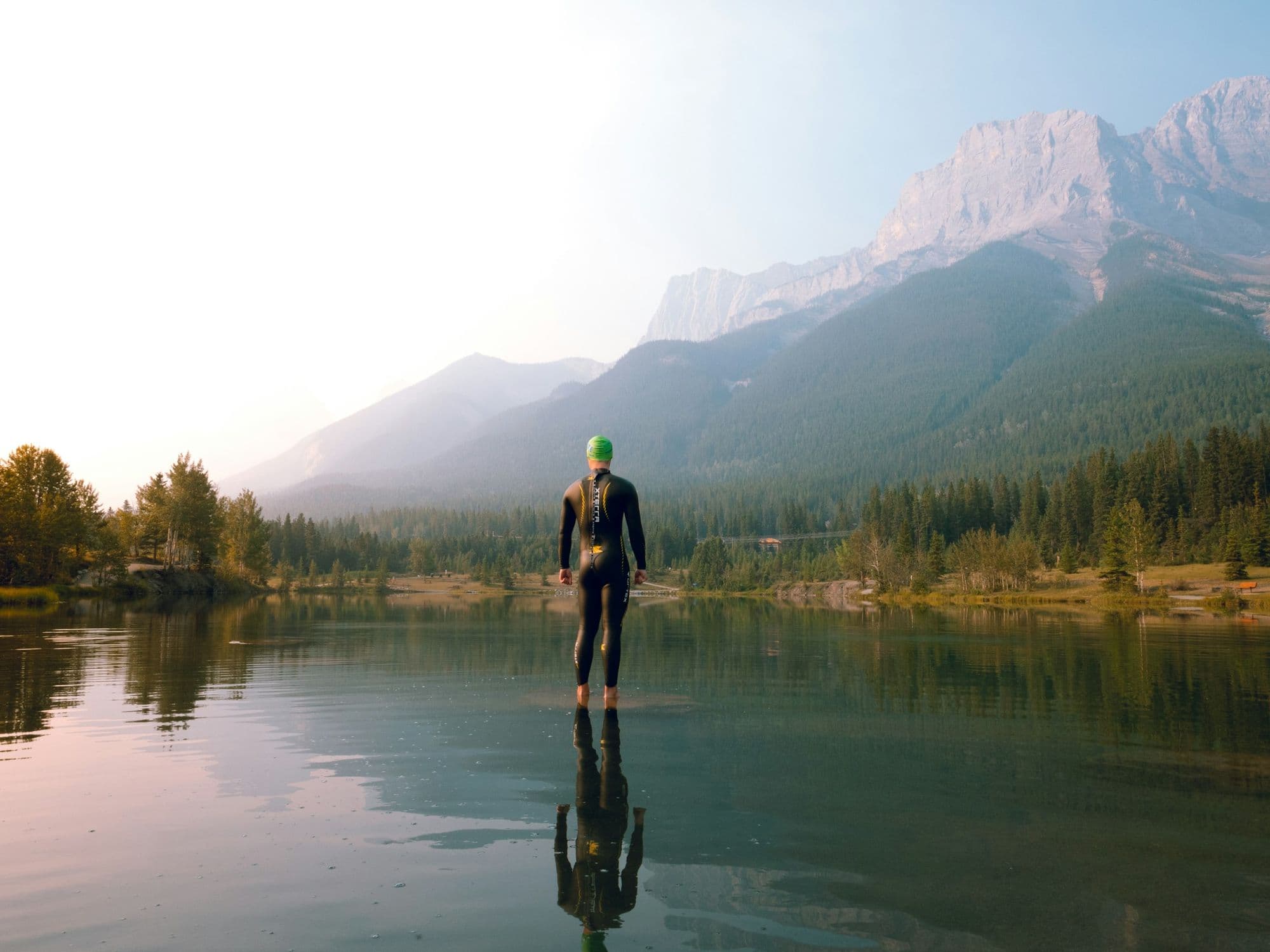
For most age-groupers the swim is where technique pays most. Get some coaching or video feedback, swim regularly rather than long, and practise in open water and in your wetsuit before race day. Sighting and a calm start matter more than a few seconds per 100 m.
Bike: the biggest slice of your day
You’ll spend roughly half your race on the bike. Build long rides steadily, practise in the position you’ll race in, and above all practise eating and drinking on the bike: that’s where most of your race fueling happens.
Run: protect your legs
Running causes the most injuries, so build run volume gradually and keep most runs easy. Short runs straight off the bike teach your legs the strange feeling of running after cycling.
Race-day basics
- Pace the bike so you can still run: if it feels easy at 40 km, that’s right.
- Fuel from early on the bike; see the fueling calculator.
- Rehearse your transitions at home: wetsuit off, helmet on, shoes ready.
- Use the race time predictor to set realistic split targets.
Where FNISH comes in
A 70.3 plan has a lot of moving parts. The FNISH app trains you for it the same way it does everything else: one race, one complete plan, built around your actual week, with one session a day and a brick as one. Our race time predictor and fueling calculator cover triathlon too.